
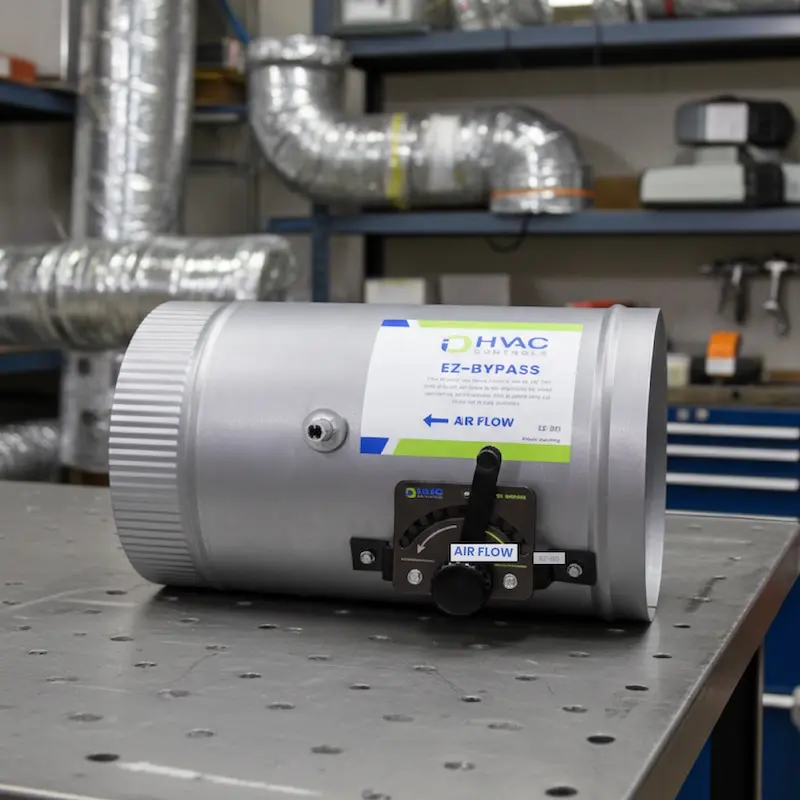
A damper is supposed to solve the problem, not become the problem
Most of the time, when someone says they need a damper, what they really mean is: this system isn’t behaving. One room runs hot, another runs cold, the return smells like the garage when the exhaust fan kicks on, or a zoned system gets loud and pushy on small calls. The damper is the tool you reach for because it gives you control.
But here’s the part nobody tells you until you’ve lived through a few callbacks: a damper can absolutely create the very issues you were trying to fix. If it’s undersized, installed in turbulent airflow, twisted in the duct, leaking around the frame, or wired to the wrong output with a transformer that can’t keep up, it’ll work in the sense that it moves, while the system gets noisier, airflow drops, static climbs, and comfort still isn’t right.
This guide is how I think through damper installs in the field, especially on zoning add-ons, comfort complaint fixes, basic airflow balancing, backdraft problems, and code-required applications. There are five decisions that matter most. Get them right and dampers stop being mysterious and start being boring (exactly what you want).
The 5 decisions:
- Match the damper to the job
- Match the damper to the duct size
- Put it in stable airflow and where you can service it
- Install it square, supported, and sealed
- Wire it for the right damper type with enough transformer VA under load
1) Start by matching the damper to the job you’re trying to do
Before you think about where it goes or how you’ll wire it, slow down and ask one question:
What am I trying to control: zone airflow, balance, pressure, or direction?
A damper is like saying a control board. It doesn’t tell you enough to pick the right part.

If you’re building true zoning
You need a motorized zone damper meant to open and close on command reliably, repeatedly, and predictably. Zoning isn’t set-and-forget. It’s cycling dampers based on calls, pressure strategy, and system behavior.
A manual balancing damper might look like it could do the job if you squint hard enough, but it’s not built for that life. It won’t give you repeatable open/close control, and it won’t integrate cleanly with a zone panel.
Zoning Examples:
- RD-XX Retro Series Zone Dampers: designed to quickly add zoning to an existing duct system and work with most zone control panels using standard thermostat wire.
- D-XX D-Series Two-Position Round Dampers: galvanized steel, spring return actuator, shipped ready for installation (also includes a simple minimum-position adjustment).
- HD-XXXX Rectangular Zone Dampers: extruded aluminum parallel blade with spring return actuator; also includes a minimum-position adjustment
If the goal is trimming airflow
If one room always gets too much air and another doesn’t get enough—and you’re not trying to actively cycle zones—you’re usually better off with a balancing damper. You dial it in, lock it down, and it stays there.
Balancing Examples:
- MBD-XX / MBD-XXXX Manual Balancing Dampers: set-and-stay balancing.
- BAL-XX / BAL-XXXX Electronic Balancing Dampers: remote-controlled airflow balancing designed for hard-to-reach / finished ceiling installs so you can fine-tune without cracking open ductwork later.
If you’re dealing with static pressure problems in a zoned system
That loud and pushy zoning behavior on small calls is often a pressure-management problem. That’s bypass territory.
Bypass Examples:
- EB Series Electronic Bypass Dampers (EB-XX / EB-XXXX): automatically bypass excess air when static pressure increases due to closing zone dampers (uses a static pressure control for setpoint adjustment).
- EZ-BD-XX: constant-pressure regulating bypass damper for forced-air zoning systems to relieve excess static pressure (compact, installs in any direction).
If airflow is going the wrong direction (drafts, odors, backfeeding)
That’s a direction problem, not a balance problem—typically handled with a backdraft damper (one-way airflow). This is often outside the typical zoning/balancing damper conversation, so make sure you’re choosing a damper specifically designed for backdraft prevention and installed per its airflow requirements.
If the damper exists because of code / life safety
Fire/smoke dampers are a different world. The damper isn’t just controlling comfort; it’s part of a safety system. Manufacturer instructions, ratings, and inspection requirements aren’t optional—and you should avoid mixing comfort/zoning damper assumptions into a life-safety application.
Bottom line: once the damper type matches the job, everything else gets easier—because you’re no longer forcing the wrong tool to act like the right one.
2) Size it to the duct so you don’t fix comfort by permanently choking airflow
Here’s a common trap: you’re solving a comfort issue, so you add a damper…and the system gets quieter in one room but worse overall. Or it gets loud when the damper moves. Or static pressure climbs and airflow falls off.
That usually traces back to one mistake: the damper didn’t match the duct size.
Think about sizing the same way you think about fittings:
- If it’s an 8″ round, use an 8″ round damper.
- If it’s a 10×8 rectangular, use a 10×8 damper.
The reason isn’t just “because it fits.” The duct size represents an airflow pathway that was (at least in theory) selected for a certain amount of air. When you neck down to a smaller damper because that’s what you had, you haven’t just added a control point—you’ve added a permanent restriction. Even when the damper is “open,” the system is now paying a pressure penalty to push air through a smaller opening area.
And that’s the sneaky part: electrically, everything looks fine. The damper opens, the panel calls, the motor turns. But performance-wise, you’ve created extra pressure drop.
Install tell: if the damper “works” electrically but you see higher static, more noise, less airflow, longer runtimes, or unstable zoning on single-zone calls, treat it like a sizing/transition problem first.
When you have to transition sizes
Sometimes you do have to reduce or expand. If you do, do it in a way that keeps airflow smooth:
- Use a gradual transition so the air can change shape without turning into turbulence.
- Avoid a quick neck-down right at the damper blade. Turbulence at the control point makes everything worse: more noise, more pressure, and inconsistent behavior.
Bottom line: a damper that works electrically but drives static pressure up is still a bad install. Matching the damper to the duct keeps you in control of comfort without paying for it in airflow.
3) Put it in a calm spot you can reach later
If you’ve ever heard a damper whistle, rattle, or bang, you already understand why placement matters. Dampers don’t like chaos. They behave best when airflow is stable and predictable.
Placement guideline
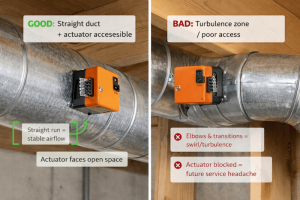
Aim for a straight section of duct whenever you can, and avoid installing the damper immediately at:
- elbows
- takeoffs
- abrupt transitions
Those areas create swirl and turbulence. Turbulent air is noisy, and it can make the damper’s control feel inconsistent because the pressure around the blade isn’t steady—especially on motorized dampers.
Actuator access
The other half of placement is simple: can you get to the actuator later? Dampers eventually need attention: wiring gets checked, motors get replaced, settings get verified. If the actuator is buried against a joist bay or tucked into a spot that requires cutting duct to reach, you just turned a quick troubleshooting step into a messy job.
A good damper install is one where the damper sits in predictable airflow and the actuator is positioned so your hands and a meter can actually get to it.
4) Install it like a control point, not just a piece of sheet metal
Mechanically, the goal is simple: it needs to move freely, hold position, and keep air from cheating around it. But a lot of damper problems are caused by basic mechanical issues that only show up once the system is running and the duct is under pressure.
Mechanical checklist
- Orientation: verify the airflow arrow (it’s there for a reason).
- Square + true: damper sits straight (no twist), blade/shaft move freely without rub or bind.
- Support: duct is supported on both sides so the damper body isn’t being pulled out of alignment.
- Seal: foil tape or mastic all joints so air can’t bypass the damper.
If you don’t seal the joints, air will bypass the damper instead of obeying it. And when air can sneak around your “control point,” you lose the entire reason you installed the damper in the first place.
5) Wire it so the zone panel and transformer aren’t fighting you
A lot of “bad damper” calls end up being wiring and power calls. Not because someone was careless—but because dampers are one of the few components that reveal transformer weakness and compatibility mistakes fast.
When multiple dampers move at once, everything that looked fine on a meter with no load suddenly turns into chatter, stalls, buzzing, and intermittent behavior.
Step one: confirm 24VAC under load
It’s easy to measure 24V with nothing happening. It’s different when several dampers try to drive at the same time. If the voltage sags, actuators may not complete their stroke, may chatter, or may fail in a way that feels random.
That’s why “it works sometimes” is often a power story, not a damper story.
Step two: size transformer capacity for worst-case VA draw
The transformer doesn’t care that each damper only needs “a little.” It cares about the total VA draw when the system is doing its hardest work—multiple zones calling, panel energized, dampers moving.
Quick VA check: add up the VA for:
- all dampers that could move at once
- the zone panel
- any other 24V loads
Size the transformer for the worst-case “everything moves together” moment—not the average.
Step three: match damper type to panel output type
This is the wiring trap that turns into “mechanical” symptoms.
- Power open / spring close: opens when energized, closes when power is removed.
- Power open / power close: needs power in both directions and typically uses different terminals/outputs to drive open vs close.
If you mismatch damper type and panel output, you can end up with a damper that acts backwards, never closes properly, or behaves in a way that looks like binding when it’s really a control problem.
Step four: label everything while it’s still open
Write down zone name, damper location, and terminals while you’re standing there with the ceiling open and the zone names fresh in your head. That one step turns future troubleshooting from a guessing game into a five-minute confirmation.
What Quiet Airflow Really Means
When dampers create problems, it’s rarely because dampers are complicated. It’s because the install accidentally added restriction, turbulence, mechanical binding, leakage, or electrical instability.
The good installs usually have the same DNA:
- the damper type matches the job
- the damper matches the duct size so you’re not baking in pressure drop
- it’s placed in stable airflow with an actuator you can reach later
- it’s installed straight, supported, and sealed so it controls air
- and it’s wired with the right output type and enough transformer VA to move everything under load
Do that, and the damper stops being the problem. It just quietly does its job exactly like it should.