
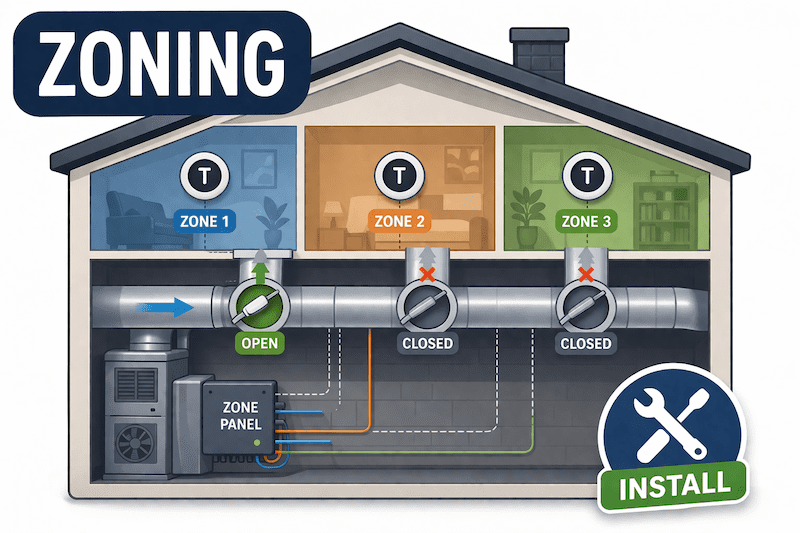
Zoning is one of the best ways to fix uneven comfort like an upstairs that’s always warmer than downstairs, a sunny room that never matches the rest of the home, or bedrooms that need different settings at night.
But zoning isn’t as easy as add dampers and extra thermostats. It changes how air moves through the duct system during operation. When only one zone calls, the system may try to move the same airflow through fewer open ducts. That’s where noise, high pressure, and equipment stress show up if the plan isn’t built around airflow.
This guide walks through zoning the way it needs to be installed: confirm the system is a good candidate, plan dampers and controls together, build a pressure strategy, then wire and commission it so it stays stable long-term.
Zoning Quick Start Checklist
Use this as your fast planning filter before you commit to a zoning layout.
- Confirm equipment type + control needs: conventional vs heat pump, staging/variable operation.
- Check minimum airflow risk: what happens if only the smallest zone calls?
- Define zones with airflow in mind: avoid zones that are too small.
- Pick a pressure strategy early: minimum-open rules, staging, dump/relief options, or static pressure control.
- Verify 24V power capacity: zone panel + dampers + accessories at the “worst moment” (multiple dampers moving).
- Commission from the worst-case condition: test a small-zone call and verify protections behave correctly.
What Zoning Does
What is zoning for
Zoning gives different areas of a home their own temperature control instead of forcing the entire house to follow one thermostat.
What zoning changes
In a single-thermostat setup, most supply paths stay open most of the time. With zoning, when only one area calls, other areas may be partially or fully closed. The system is now moving air through fewer open ducts during some calls, which can raise duct pressure and change return-side behavior.
What is doesn’t fix
Zoning can fix comfort imbalance. It does not magically fix ductwork that’s undersized, poorly laid out, or already restrictive. If the duct system can’t comfortably carry the airflow the equipment produces, zoning can make those issues more obvious, especially on small zone calls.
What to do
- Confirm the comfort problem is from different areas needing different control, not because the duct system can’t move enough air.
- Plan zoning so the system still has enough open duct area during small calls.
System Suitability
Equipment type and control complexity
Zoning is typically simpler on basic single-stage systems. Multi-stage and variable-speed systems can absolutely be zoned, but the controls and airflow behavior get more complex. Heat pumps also add mode logic and backup heat decisions, your zoning controls must match how the heat pump is intended to run.
Minimum airflow and why it matters
Every system needs a minimum amount of airflow to operate safely and efficiently. When zoning closes down duct area, pressure rises and airflow can drop. In cooling, low airflow increases the risk of the coil getting too cold. In heating, it increases the chance of overheating and safety shutoffs.

When zoning fits vs when it fights the system
Zoning fits when there are clear comfort differences, and the system can stay stable during partial calls, either because zones are sized to maintain airflow or because the equipment can reduce output smoothly.
Zoning fights when zones are too small, ductwork is already restrictive, or the equipment can’t back off when fewer areas are open. It may still be possible, but it requires stronger planning around pressure and protections.
What to do
- Identify the smallest possible operating condition: “only Zone X calling.” Then plan around it.
- If the system is already noisy/high restriction today, treat zoning as a higher-risk install that needs a stronger pressure strategy.
Dampers: Selection and Layout
Zoning dampers direct airflow to the calling zones. Correct sizing, behavior, and placement are what make zoning feel stable and make service work manageable later.
Shape and sizing: match the duct
Use round dampers in round duct and rectangular dampers in rectangular duct. Match the duct size. Don’t step down because it’s on the truck. A too-small damper becomes a built-in restriction and can create noise and pressure problems even with correct zoning logic.
Actuator behavior: what happens on power loss
Two common behaviors:
- Power-open / spring-close (power opens; spring returns when power is removed)
- Power-open / power-close (powered both directions; may hold position on power loss)
This matters because the home’s default airflow during a power or control issue depends on what opens vs closes by default. You want a default behavior that won’t block airflow in a way that can stress the system.