

ESP is simple: it’s the pushback your blower feels outside the cabinet. The trap is how easy it is to get an inaccurate reading when measuring it.
Here’s a repeatable field method to get clean ESP without lab gear so your diagnosis is based on the system, not turbulence.
What Tools Do You Need?
If you want clean, trustworthy ESP numbers, these are your foundation tools and tips.
- Manometer (digital or analog): Digital is easier for most techs because it’s faster to read and usually steadier, but analog can work if you can read it clearly. Either way, what matters is resolution (ESP changes are small), stable readings (not bouncing all over), and tight tubing connections (leaks and loose fits = junk data).
- Static pressure tips/probes (non-negotiable): This is the difference between a useful test and a confusing one. A static tip helps you measure static pressure (system pushback), not air velocity and turbulence right at the hole. Without a static tip, you’re often measuring whatever the air is doing right there, which leads to random numbers and bad calls. In plain terms: static tips make your readings about the system, not the swirl.
- Basics to make it repeatable: Drill + correct bit for test ports, test port plugs, foil tape or mastic to seal.
- Habit that prevents goofy numbers: Zero the manometer before every job, and re-zero if the readings start drifting or look wrong.
Note: Drill thoughtfully. Don’t send a bit into a coil, heat exchanger area, or wiring.
Where to Measure ESP
External static pressure is defined by location. ESP is the pressure your blower sees outside the equipment cabinet. So your job is simple: pick one supply test point and one return test point that represent the duct system pushback—and use the same locations and rules every time.
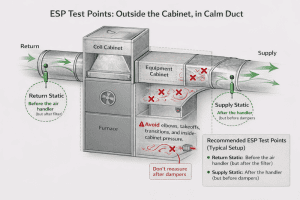
Pick your standard and stick to it
Decide whether your return test point includes the filter/grille pressure drop or excludes it. Either approach can be valid. Mixing methods is what makes trend data useless—so pick one, write it down, and repeat it every job.
Supply static
Measure in the supply plenum in a straight, stable section of duct. You generally want to be past the equipment internals you’re not trying to count as external, then ideally before big branches/takeoffs so you’re reading the main duct pressure, not a weird branch effect.
Avoid elbows, transitions, and takeoffs because air is swirling there. Rule of thumb: aim for the straightest section you can find—a few duct widths away from anything that creates turbulence.
Return static
Measure in the return drop or return plenum in a stable section, again avoiding sharp turns and turbulence zones. Whether you include or exclude filter/grille drop is up to your standard—just stay consistent and note what you included.
Furnace + coil setups (common mistake)
Many techs drill wherever it’s convenient and accidentally capture internal cabinet effects (coil cabinet, heat exchanger area, blower compartment turbulence). The principle is simple: your two pressure pickups should represent the duct system the blower is pushing against, not the chaotic pressures inside the equipment.
Consistent, calm duct locations = usable ESP numbers.
The Field Test
The goal is to measure the blower’s pushback under a steady, real operating condition—not during a moment when the system is changing.
Step 1 — Stabilize the system.
Run cooling (often best) or steady heat. Don’t test during ramp-up. Wait a few minutes until the readings stop drifting.
Step 2 — Drill calm test ports.
One return, one supply—straight duct/plenum sections, away from turbulence. Drill carefully (watch coil/wiring) and plan to seal the holes when you’re done.
Step 3 — Measure return static (negative).
Probe the return port and record the number (usually negative on the suction side).
Step 4 — Measure supply static (positive).
Probe the supply port and record the number (usually positive on the push side).
Step 5 — Calculate ESP.
ESP = Supply (+) + |Return (–)|
Example: +0.28 and –0.32 → ESP = 0.28 + 0.32 = 0.60 in. w.c.
Step 6 — Log conditions so the number means something.
Note filter type/condition, blower speed setting, heat/cool stage (if known), doors open/closed, and any accessories running (ERV, humidifier). If the system is zoned, note how many zones are calling and whether this was a baseline or worst-case test.
What Good Looks Like
A good ESP number is any reading at or below the unit’s Rated External Static Pressure (nameplate or install manual). Don’t assume 0.50 in. W.c. is the ideal number. It’s common, not universal.
Use ESP as a sorting tool:
At or under rating
The duct-side resistance is probably acceptable. If comfort issues are still there, start looking at airflow delivery and distribution (registers, balancing, zoning setup), equipment performance (charge, coil condition), and controls/operation (blower speed settings, staging).
Slightly over rating
You’ve got extra pushback somewhere. Start hunting the usual restrictions: filter and filter rack, dirty coil, return limitations, undersized duct, crushed/long flex runs, tight grilles, or zoning dampers creating pressure when only a small area is open.
Way over rating
Expect the classic symptoms and callbacks like noise/whistle, low airflow, coil freeze, high temperature rise, blower stress, and inconsistent comfort. At this point, ESP is likely the root cause, not just a side note—and fixing restrictions or adding proper pressure management (especially with zoning) usually becomes the main job.
If zoning is part of the system, high static often shows up when only a small area is open. That’s why modern zoning needs built-in static pressure control—so pressure is managed without relying on a bypass duct.
For example, iO’s ZP4-ESP and ZP6-ESP panels use a static pressure sensor to monitor duct pressure and will power non-calling zone dampers open just enough to relieve excess pressure, designed to eliminate the need to install a bypass damper in typical applications.
Common Bad Readings and How to Avoid Them
The fastest way to get burned with ESP is to take a real-looking number that isn’t measuring what you think it is.
Bad reading #1: measuring inside the cabinet.
If you’re right at the blower, coil face, or other internal compartments, you’re not measuring external pressure—you’re measuring turbulence and internal cabinet effects.
Bad reading #2: being on the wrong side of the filter or coil without realizing it.
Decide on your standard (are you including filter/grille drop or not?) and label it in your notes. Either method can work, but mixing methods makes comparisons meaningless.
Bad reading #3: tool setup problems.
Kinked tubing, water trapped in the line, loose fittings, or skipping proper static pressure tips can create fake numbers or jumpy readings because you’re sampling chaos instead of true static pressure.
Quick fixes include straightening the tubing, draining it, tightening connections, and always using static tips.
Bad reading #4: testing at the wrong operating condition.
Blower speed and staging change pressure a lot, so measure at the condition you’re actually diagnosing and write it down.
Bad reading #5: doors open vs. closed.
Door position can change return pressures (especially in tight homes), so be consistent and note your test condition.
Bad reading #6: zoning with only one zone calling.
High static can be normal in a single-zone call—but it still has consequences (noise, airflow drop). For baseline, test with a typical whole-system call. For worst-case, test single-zone and label it clearly.
If worst-case static is excessive, you need a pressure-relief strategy (bypass or ESP-style control that opens non-calling zones slightly to bleed off pressure).