
What Is a Bypass Damper and Do You Need One?

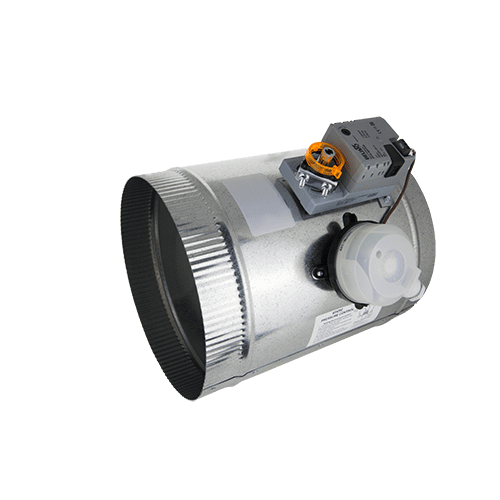
EB Series Round Dampers (EB-XX) iO HVAC Controls Unassigned iO HVAC Controls 14608

On a zoned HVAC system, high static pressure usually shows up as airflow noise. You get a call from a homeowner saying that the system sounds strained. Then you see signs of restricted airflow when only a small zone is open.

A bypass damper can help in the right application by relieving excess static pressure during those worst-case calls. But it is not a cure-all for bad duct design, undersized returns, or poorly planned zoning.

This guide explains what a bypass damper does, what problem it is actually solving, the tradeoffs to consider, and how to decide whether bypass is the right answer—or whether the better fix is improving zoning strategy or airflow design.

What Is a Bypass Damper?

A bypass damper is a pressure-relief device installed between the supply and return ductwork. When static pressure rises above the desired level, the damper opens and routes some air back to the return side.

In a zoned system, this usually happens when one or more zones are closed and the blower is still trying to move substantial airflow through a much smaller open duct path. The result is excess static pressure, added noise, and more system stress.

The bypass damper’s job is to relieve that pressure in a controlled way. What it does not do is correct an undersized duct system, restrictive return path, or poorly planned zone layout.
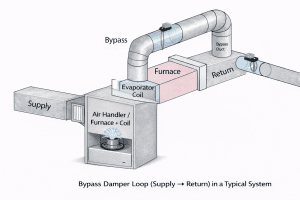
bypass damper loop

The next step is understanding why static pressure rises in real systems, because zoning is only one of the common causes.

When Static Pressure Rises

Static pressure rises whenever the air-moving side of the system is trying to deliver airflow that the available duct path cannot handle easily. In the field, that usually shows up during small-zone calls, restrictive return conditions, or duct systems that were already marginal before zoning was added.

Zoning when only one small area is calling

One common case is zoning when only one small area of the home is calling. If most of the home is closed off and only a small section is open, the blower is still moving air, but there is not enough open ductwork to carry it smoothly. The air starts to back up, and pressure builds in the supply ducts.

Too many zones—or zones that are too small

Pressure can also rise when there are too many zones or when the zones are too small for the amount of air the equipment normally moves. Even if the zoning is working as designed, the open zones may not provide enough airflow capacity during certain calls.

Variable-speed blowers that ramp up

Another factor is variable-speed blowers. These blowers can ramp up to try to maintain airflow. If the duct system is restrictive, the blower may push harder to compensate, which can raise pressure even more.

High-resistance duct setups (even without zoning)

Pressure also rises in high-resistance duct setups, even without zoning. Dirty or restrictive filters, undersized returns, tight supply runs, and small grilles can all increase system resistance. In those cases, the system is already fighting airflow restriction, and the added pressure shows up quickly.

Once you know what drives pressure up, it is easier to understand bypass options and how much control a given application may need.

Common Bypass Damper Types (and How They Open)

Bypass dampers differ mainly in how they respond to pressure and how much control they provide. The difference comes down to whether the job needs a simple constant-pressure bypass solution or a more controlled electronic bypass approach tied to static pressure management.

In iO’s lineup, two practical categories are most relevant:

  • Constant-pressure bypass dampers, such as the EZ-BD, which are designed for simple installation and automatic pressure relief.
  • Electronic bypass dampers, such as the EB Series, which work with the iO-SPC static pressure control to modulate bypass more precisely as system conditions change.

The key question is not just what style the damper is, but how much control the application needs during worst-case zoning conditions.

How iO Approaches Bypass Control

iO offers bypass solutions for different application needs. The EZ-BD bypass damper is designed as a constant-pressure regulating bypass damper with a compact form factor, simple setup, and installation flexibility in either vertical or horizontal positions. For applications that need more controlled static pressure management, iO’s EB Series electronic bypass dampers work with the iO-SPC static pressure control to modulate bypass based on duct conditions.

In other words, the right bypass approach depends on how much control the system needs and how the zoning design behaves during worst-case calls.

What Bypass Can Help With

A bypass damper can help when the real problem is that the system is trying to move more air than the open duct paths can handle—especially during zoning calls when only part of the home is open.

Less noise during high-pressure moments

One of the most noticeable benefits is less noise. When pressure builds up, air can start rushing through the remaining open vents and grilles, which creates whistling, whooshing, and sometimes rattling. By giving some of that extra air a controlled shortcut back to the return, a bypass damper can bring the pressure down and quiet the system.

Reduced pressure spikes on partial-zone calls

It can also reduce extreme pressure spikes during partial-zone calls. In zoning, this is common when only one small zone is calling and everything else is closed. Pressure can climb quickly because the blower is still pushing hard. A bypass damper helps smooth that out by opening as pressure rises, so the system does not hit peak static pressure conditions as easily.

Fewer issues when pressure is the trigger

It can also help reduce problems caused by airflow stress when pressure is the real trigger. High pressure often goes hand in hand with lower airflow across the equipment. That is when you may see things like the system shutting off on a safety limit or the cooling coil getting too cold and beginning to ice up. A bypass damper does not fix every airflow problem, but when high pressure is the underlying cause, it can reduce the stress that leads to those symptoms.

That can mean fewer comfort complaints, less objectionable airflow noise during small-zone calls, and better system stability when excess static pressure is the real trigger.

Those are the benefits, but bypass has tradeoffs. To decide if you need one, you also need to understand what bypass does not fix.

Tradeoffs: What Bypass Does Not Fix

A bypass damper can be helpful, but it is important to understand what it does not do, so it does not get treated like a cure-all.

It does not fix duct sizing or duct design

First, it does not make the duct system bigger or better designed. If the real issue is that the ducts, especially returns, are undersized or too restrictive for the amount of air the equipment is trying to move, a bypass damper can reduce the pressure symptoms, but it does not fix the root cause.

In many cases, bypass reduces the symptom without removing the restriction. If the real issue is undersized returns, aggressive zoning, restrictive grilles, or a duct layout that cannot support the blower’s airflow during small-zone calls, bypass may stabilize the system, but it does not correct the underlying airflow path.

It recirculates conditioned air back to the return

Second, bypass works by sending some supply air back into the return. That means some of the heated or cooled air you just paid to condition is being recirculated instead of being delivered to the rooms.
Bypass also comes with an efficiency tradeoff: some conditioned supply air is redirected back to the return instead of being delivered to occupied spaces. That can reduce delivery efficiency and should be considered a pressure-relief strategy, not a substitute for proper duct design or zone planning.

It can hide the real restriction

Third, bypass can hide the real problem. If you install one and the noise goes away, it is tempting to declare victory, but the original restriction may still be there: undersized returns, poor transitions, overly restrictive grilles, tight filters, or crushed duct runs.

A bypass damper may make the system quieter and more stable, but the best long-term fix is still improving the airflow path when possible.

In some systems, the better long-term answer is not adding more bypass, but using zoning controls that manage static pressure more intelligently from the start.

Want a zoning-first way to handle high static pressure?

See how iO’s ESP-enabled panels (like ZP4-ESP / ZP4-ESP-FAV) use duct pressure sensing to relieve excess pressure by slightly opening non-calling zones reducing the need for bypass dampers.

Do You Need a Bypass Damper?

A good way to decide if a bypass damper makes sense is to look at what the system does during its worst-case situation and then work backward.

Step 1: Look at the smallest zone calling by itself

First, think about the smallest zone calling by itself. This is the moment when the duct system has the least open path for air to move through, but the blower is still trying to move a lot of air. If that worst-case call creates loud airflow, whistling, or the system seems to struggle, it is a sign pressure may be building too high when only a small part of the home is open.

Step 2: Measure external static pressure (don’t guess)

Next, do not guess—check the external static pressure (ESP). That number tells the truth quickly. If static pressure stays reasonable even in the worst-case call, a bypass damper probably will not add much value. But if static spikes high when only that small zone is open, you have confirmed the actual problem a bypass damper is meant to relieve: too much pressure from too little open duct area.

Step 3: Consider zoning improvements before adding bypass

Finally, consider whether you can improve the zoning setup before adding bypass. Sometimes the better fix is to make sure zones are not too small, set a minimum open strategy so at least one additional area stays open to handle airflow, or adjust how the system runs so it does not push maximum airflow when only a small zone is calling.

If the application calls for bypass relief, selection should match the level of control the job requires, from a simple constant-pressure bypass solution to an electronic bypass damper paired with static pressure control.

Compare iO’s EZ-BD and EB Series bypass solutions or see if a zoning control strategy may be the better answer.