

Most airflow problems don’t show up as static pressure on a gauge. They show up as complaints: back bedrooms that never catch up, a clammy living room, a noisy system or long runtimes with mediocre comfort. When the equipment looks fine, it is easy to chase charge, staging, or thermostat logic instead of airflow.
Many of those symptoms share the same measurable cause: the blower is fighting resistance in the duct system. External static pressure (ESP) is how you measure that resistance. It is one of the quickest ways to explain why a system can run and still underdeliver on comfort.
What External Static Pressure Really Means
How ESP is Defined
External Static Pressure (ESP) is the total resistance the blower has to push through outside the equipment cabinet. You calculate it by taking a static pressure reading on the return side and the supply side at the manufacturer’s recommended test points, then combining them for total ESP.

Why both sides? Because the blower doesn’t just fight what’s in front of it, it fights what’s behind it too. ESP captures the pushback coming in and going out, so you’re seeing the full workload the blower is up against.
ESP is Pushback, Not Airflow
A lot of people talk about static pressure like it is airflow. It’s not.
Think of ESP as the system’s pushback. The resistance that tries to choke off airflow. It’s measured in inches of water column (in. w.c.), because duct pressures are tiny. The numbers look small, but the impact isn’t. A change you barely notice on a gauge can be the difference between a system that feels great and one where the back room still stinks.
Here’s the simple relationship:
- Airflow is what you want.
- Static pressure is what tries to stop it.
That’s why you can have high static and low airflow at the same time. When air can’t get through restrictions, pressure climbs—because the blower is pushing against a system that won’t let it breathe. ESP doesn’t tell you how much air is moving. It tells you how hard the blower is working trying to move it.
ESP vs. Static Pressure Readings
Static pressure readings at a single point—across a filter, coil, supply plenum, return drop, damper, etc.—are incredibly useful. They help you find where the restriction lives.
ESP is different. It’s a specific way of using static readings so your numbers line up with what the manufacturer’s fan tables and performance assumptions are based on. That’s what makes ESP such a powerful “truth serum” on a service call: it answers the bigger question, fast:
Is this duct system letting the blower operate where it was designed to operate—or is it forcing it to fight for every CFM?
ESP Field Check: Measure First
Before you go chasing charge, staging or something weird witht he thermostat, check ESP to get to the heart of the problem.
- Take supply and return static readings at the recommended test points (outside the cabinet) and add them for total ESP
- If ESP is high, do not start by guessing charge or staging but rather check for airflow restrictions first (filter, return path, coil, duct sizing, zoning closures)
- Use the blower performance table to confirm whether required airflow is still possible at the measured ESP
Want a fast, repeatable process? Use a simple checklist for test port placement, total ESP calculation, and what to check first when readings are high.
The Signs of ESP
Complaints
High ESP usually shows up as comfort problems. The blower may sound like it is working harder, but the space feels as if it is getting less air. You will often see weak throw, poor mixing and rooms lagging behind the thermostat. The system can be running while distribution is failing, and high ESP is often the underlying reason.
Performance Drops and Resistance Rises
Here’s the ugly part: when airflow drops, the system can’t exchange heat the way it was designed to. That means capacity and efficiency fall together, and the symptoms shift depending on the mode.
- Cooling: low airflow can pull evaporator temps down, raising freeze risk and hurting latent performance even if the stat eventually satisfies
- Heating: low airflow increases temperature rise and can lead to limit trips or unstable cycling
- Staging: higher stages usually need more airflow. If the duct system cannot support it, static climbs fast and problems show up more clearly
Equipment Starts Paying the Price
High ESP is what you call a slow mechanical tax. It doesn’t always break something today. It just makes everything work harder than it should, day after day, until a small airflow issue turns into an expensive fix. It can cause frozen coils, limit trips, and ghost issues. that come and go because airflow is collapsing under load.
And with ECM blowers, the story gets even more important: they’ll often try to power through by ramping torque to maintain airflow. That can mean long stretches near max effort. High static rarely causes overnight failure. It quietly shortens equipment life and turns a fixable airflow restriction into a motor problem later.
Where High ESP Usually Comes From
Return-Side Restrictions (Most Common)
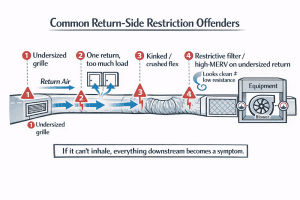
Start on the return side. Return problems are easy to miss because they are hide behind filters, door positions, and layouts that worked until something changed. A higher-MERV upgrade, a remodel, a closed door, a new grille, then suddenly the system can’t breathe the way it used to.
Common offenders:
- Plugged filters, or a “clean” filter that’s restrictive because the return is undersized (especially after a higher-MERV upgrade)
- Poor filter racks that cause turbulence, bypass, or collapse/restriction
- Undersized return grilles
- Long/kinked flex, crushed duct sections
- One central return trying to serve too much of the house
Supply-Side Restrictions (The Stacking Effect)
Supply restrictions don’t always show up as one obvious failure, they stack. One issue might be tolerable on its own, but combine a few and the blower is climbing a resistance ladder every cycle:
- Undersized trunk
- Higher pressure-drop coil
- Sharp turns
- Long runs
- Registers too small for the airflow
Noise often tracks with static. Force air through openings that are too small and velocity/turbulence rises. Pressure then turns into sound (whistling grilles, loud diffusers).
Zoning Pressure Spikes
Zoning can be great or brutal on static. When multiple zones close, the system tries to move the same air through fewer open paths. Without a pressure strategy (relief, modulation or control logic that prevents aggressive closures), ESP rises fast.
That’s why zoning can look like an equipment problem:
- Works fine with all zones open
- Gets loud, unstable, or freezes a coil when only a small zone calls
The equipment didn’t change, but the available airflow path did. Zoning without proper relief can shrink the duct system in real time, and the blower takes the hit.
Pressure Management Matters in Zoning
When zones close, you need a plan for where that air goes. Otherwise you’re asking the blower to push the same volume through fewer open paths and static climbs fast. Some systems lean on a bypass. Another approach is static-pressure-based control that prevents the spike in the first place by relieving pressure intelligently.

iO’s ESP-enabled zone panels use a static pressure sensor to watch duct pressure in real time and react when it rises above a setpoint. When a zoning call starts driving pressure up, the panel can crack open non-calling dampers slightly to create relief, softening the pressure swing and often eliminating the need for a bypass damper, depending on the application.
In the real world, bleeding a small amount of conditioned air for a short time into non-calling zones typically has minimal impact on zone temperature especially compared to the comfort problems, noise, and equipment stress that come from unmanaged pressure spikes.
Explore iO ESP Zone Panels
2-zone: single-stage applications
3-zone: heat pumps or multi-stage options
4-zone: universal zoning + ESP and versions with built-in ventilation control
6-zone: higher-zone-count universal zoning + ESP, with expansion available
So What Counts as Good ESP
You’ll hear 0.50 in. w.c. thrown around a lot, because many residential systems are rated near that. But treat it like a mile marker, not a guarantee of quiet operation, comfort, or a happy blower.
A better definition of good is this:
Can the blower deliver the airflow the system needs without living at the edge of its capability?
What’s acceptable depends on the full setup:
- Equipment model Blower type (PSC vs. ECM)
- Coil pressure drop
- Filtration strategy
- Duct design and how static was budgeted across components
So the most useful question isn’t, “Is it under 0.50?” It’s:
“Is this ESP consistent with the airflow we need, based on this blower’s performance table?”
How to Interpret ESP Plus the Symptoms
Use ESP like a quick fork in the road for your diagnosis:
- Low/normal ESP + low airflow: look at blower settings, test locations, duct leakage, or a measurement issue before blaming restrictions
- High ESP + low airflow: go straight to restrictions (filter/return/coil/duct/zoning closures)
- High ESP + an ECM working hard: expect noise, icing risk, and long-term motor stress if the root cause isn’t fixed
The Takeaway
Measure Early to Stop Chasing Symptoms
ESP testing gets you out of guesswork. Instead of reacting to noise, uneven temperatures, icing, or long runtimes one at a time, you can confirm whether the blower is operating against predictable resistance. That lets you prioritize real fixes: filter path, return capacity, coil drop, duct constraints, and zoning behavior in the right order.
Use ESP to Explain the Problem to Customers
When you can explain ESP, customers hear cause-and-effect not opinions. You’re not saying the equipment is bad. You’re showing that it’s being forced to work against restrictions. Often the fix isn’t replacing equipment, it’s improving the air pathways so the system can run where it was designed to run.
If Zoning Is Involved, Don’t Ignore Pressure Strategy
If a zoned system runs fine with all zones open but gets loud, unstable, or freeze-prone on small calls, treat it as a pressure management issue not just bad ductwork. As dampers close, the duct system effectively shrinks, so static pressure strategy becomes a design and control decision.
If you want zoning comfort without the static pressure penalty, look for controls with built-in pressure management. iO ESP zone panels monitor duct pressure with a static pressure sensor and can relieve excess pressure by slightly opening non-calling zones helping keep airflow stable when only small zones call.